


QUEZON CITY, Philippines (Mar 2026) — Long before the Spanish arrived, Pinoys were already crossing open seas, hunting sharks and tuna, and building lives across islands that had no land bridge to the mainland. Now, a robot is helping us figure out exactly how they did it.
Ateneo de Manila University archaeologist Dr. Alfred Pawlik introduced ArchaeoBot at the latest Ateneo Breakthroughs lecture on March 27 at Escaler Hall. The project, developed in collaboration with the Ateneo Laboratory for Intelligent Visual Environments (ALIVE), combines robotics, sensors, and machine learning into a single archaeological platform designed to excavate sites with more precision and consistency than traditional manual methods allow.
The idea grew from a straightforward problem: archaeology is physically demanding, prone to human error, and often limited by the endurance of the team in the field. ArchaeoBot is designed to take on the more demanding parts of excavation while also detecting artifacts, burials, hearths, and other subtle features that a tired or inexperienced excavator might miss or damage.
What sets it apart from a simple digging machine is its ability to learn. The robot adapts to different excavation conditions and is designed to handle not just digging but also cleaning, recording, bagging, and storing delicate finds. The goal is not to replace archaeologists, but to extend what they can do.
What the digs are actually finding
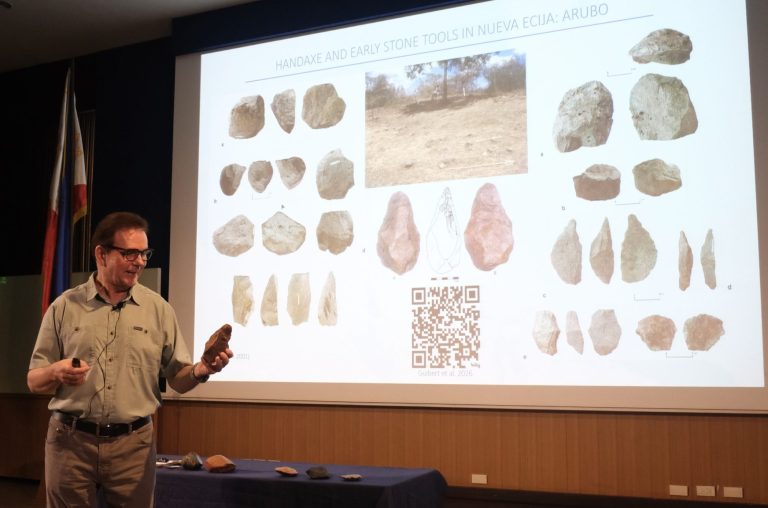
The research behind ArchaeoBot is just as striking as the technology itself. Dr. Pawlik presented evidence that humans were crossing island chains like Palawan and Mindoro as far back as 40,000 years ago, and that even earlier populations had reached Luzon hundreds of thousands of years before that.
These were not accidents. Most of the Philippine archipelago was never connected to the mainland during the Ice Age, meaning these journeys required deliberate and repeated sea crossings. Dr. Pawlik calls the route through Palawan and Mindoro the “Palawan-Mindoro Corridor,” framing the Philippines not as a distant endpoint of human migration but as a central gateway in the broader movement of people across Southeast Asia.
The physical evidence backs this up. Remains of tuna, sharks, and other open-water species point to advanced fishing strategies. Bone gorges and modified stone weights suggest a mastery of marine technology that persisted for millennia. These early communities were not passive settlers. They were adaptive and innovative, working with both land and ocean to survive.
“We owe the anthropologists and their scholarship that we get a better picture of generations and civilizations to which we would otherwise have no access,” said Dr. Maria Luz Vilches, Vice President for Higher Education at Ateneo, in her opening remarks.
The full lecture is available at ateneo.edu/breakthroughs. For interview requests, contact Dr. Pawlik at [email protected].


