

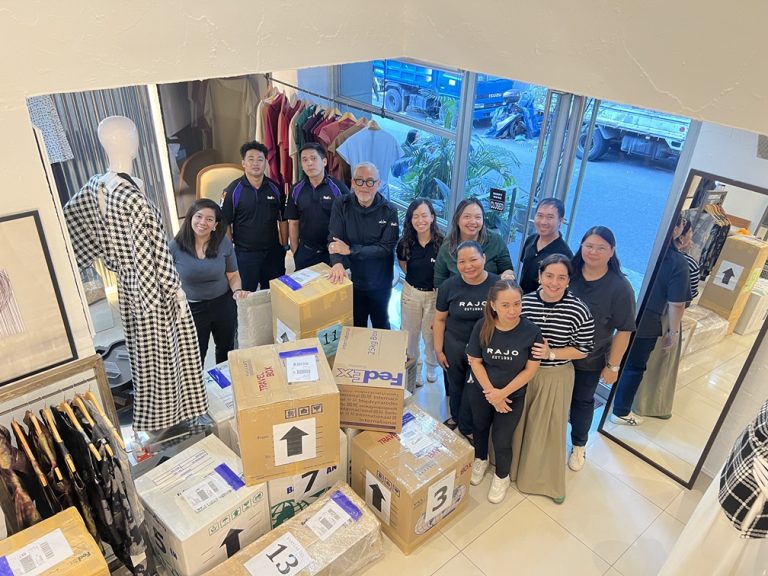

MANILA, Philippines (Apr 2026) — Rajo Laurel has dressed heads of state, sent gowns to Pinoys across five continents, and built one of the most recognizable labels in Philippine fashion. But none of it matters if the dress does not arrive on time.
For a designer whose clients commission pieces for weddings, state occasions, and milestone moments, a delayed shipment is not just an inconvenience. It is a missed memory. That reality pushed Laurel toward a logistics partnership that has become, in his words, an extension of the creative process itself.
“What I like about FedEx is that they allow me to be creative and they take care of everything that comes after,” Laurel says. “I’ve never really had to worry about size or weight of the freight shipments. I’m more concentrated on the creative aspect.”
The arrangement flips the usual order of things. Rather than designing around shipping constraints, Laurel creates first and then works with FedEx on how to move the pieces, whether that means specialized protective packaging for heavily textured couture, navigating international customs documentation, or managing timelines across multiple regions simultaneously.
“There’s an emotional thing when you send something that’s very special. In Filipino, we say ‘pinag-iingatan natin,'” Laurel explains. “We use FedEx for these pieces because we know they will arrive on time and cared for at every step of the shipment journey.”
His clients span the ASEAN region, the United States, and Europe, many of them Pinoys overseas commissioning garments that carry something beyond aesthetics. “What we do here is we just don’t sell clothes. We sell memories. We share life highlights,” Laurel says. “Wherever there’s a Filipino, there’s a tangible customer base. For those who want a connection back home, that’s the space where we operate. We provide that comfort of home.”
Looking ahead, Laurel is focused on deeper expansion within ASEAN, with material innovation also on his radar, particularly around abaca fiber, a material with personal roots: his great-grandmother built her livelihood on abaca rope. This summer, he launches his “Playtime” collection, drawing from childlike innocence and creativity.
For Pinoy entrepreneurs with global ambitions, the Rajo Laurel model offers a straightforward lesson: creative vision and operational discipline are not opposites. Choosing the right partners to handle what happens after the work is done is part of the work itself.


